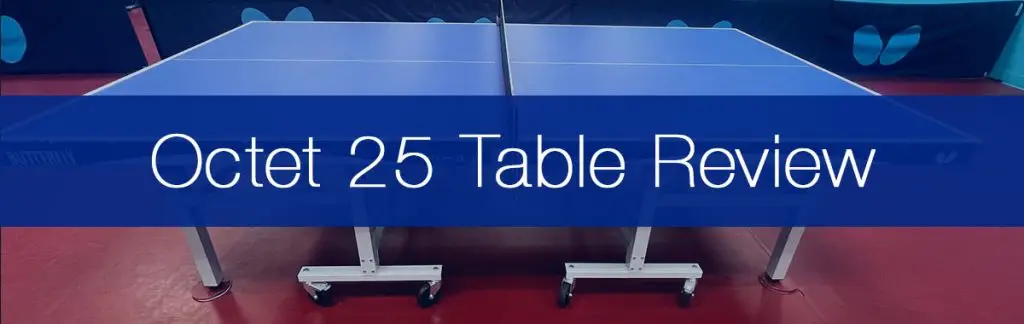
If you’re shopping for a table tennis table that can handle tournaments and serious training sessions, the Butterfly Octet 25 keeps coming up. It promises pro-level specs with practical storage.
The Octet 25 isn’t cheap at between $2,100 and $2,500, so this review focuses on whether the performance and durability justify that premium.
We’ll cover how the table performs during play, whether the build quality holds up over years of heavy use, how practical the storage system actually is, and whether the price makes sense for your situation.
Let’s get into it!
Product Specifications

- Average RRP: $2,500
- Surface Thickness: 25 mm
- Stand-Alone Halves: Yes
- Top Material: Wood
- Wheels: Yes
- Weight: ~275 lbs (125 kg) fully assembled.
- Storage Dimensions: 60″ L × 26″ W × 61″ H
- Warranty: 5 years.
- Location: Indoor Only.
- ITTF Approved: Yes.
The Octet 25 sits firmly in tournament-grade territory. At its core is a 25 mm wooden top with Butterfly’s Perfect Grip coating, which is the same surface technology you’ll find on their flagship Centrefold tables used at World Championships.
The frame is where Butterfly separates itself from budget competitors. A 2″ steel apron wraps the entire perimeter, with thick square-tube legs and cross-bracing underneath.
At roughly 275 lbs fully assembled, this thing isn’t going anywhere once you’ve set it up. That’s a heavy table. Compare it to recreational tables at 180-200 lbs, and you’ll understand why the Octet is incredibly stable.

What makes the Octet practical for clubs (and ambitious home setups) is its two-piece rollaway design. Each half rolls independently on four 4″ locking casters, and when folded together for storage, the entire unit is only about 25″ deep, which is surprisingly compact for a table this heavy-duty. The halves lock together securely, so you’re not wrestling with them rolling apart.
Each corner leg has an adjustable leveler (critical for getting true bounce on imperfect floors), and Butterfly normally includes their National League net set in the box, which is a great tournament-grade net with padded clamps.
Setup and Assembly
The Octet 25 ships in two large crates and requires assembly. Each half weighs approximately 138 lbs, making the initial unboxing and positioning the most physically demanding part of setup.
You’ll need 2-3 people to safely move the halves from the crate to your assembly area. Clubs often opt for inside delivery service to avoid this step entirely.
Assembly itself is uncomplicated. You’re bolting the leg assemblies and wheel carriages to each table half using the included tools. The process takes about 30-45 minutes with two people. The instructions are clear, and there aren’t any fiddly alignment issues.
Once assembled, day-to-day setup is genuinely easy. One person can manage both halves by pulling the safety pin on each half, then guiding it down until the legs lock into position. That whole process takes under two minutes.
The safety mechanisms work well, with the pins holding securely when folded, and the leg locks engaging positively when deployed. We never had any concerns about the table accidentally folding or rolling during use.

Playing Experience & Surface Quality
The bounce quality is immediately noticeable. The 25 mm Perfect Grip surface delivers a fast, consistent response across the entire table with no dead spots, and no surprises.
The table has been tested extensively with both robot drills and match play, and the ball reacted predictably every time. The surface does feel noticeably faster than most club tables, which makes sense given it’s the same spec as tables used in World Championships.
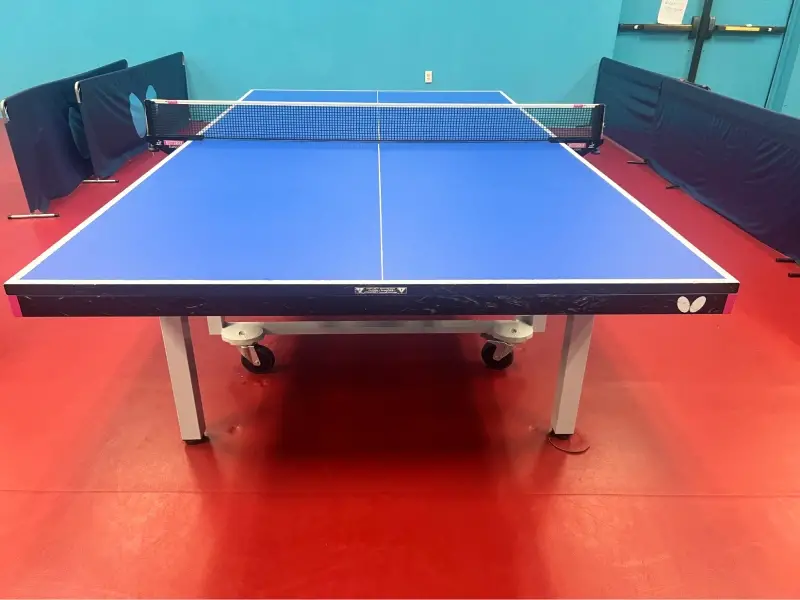
Stability is exceptional. At 275 lbs with that steel frame, the Octet doesn’t budge even when contacted by a stray hip, leg, or arm. We deliberately tested this by leaning on the table during reaches and there was zero movement or wobble.
The adjustable levelers ensure the surface stays perfectly flat, and the locking wheels mean it won’t shift position mid-game.
The included National League net set is a genuine quality piece. The padded clamps work perfectly, and the tension adjustment lets you dial in the height easily. It’s one less thing to buy separately, and it’s properly matched to the table’s quality level.
From a playing perspective, this is tournament-grade equipment. The bounce is true, the spin response is predictable, and the stability gives you confidence.
Build Quality and Durability
The frame construction is substantial. The 2″ steel apron and square-tube legs are thick gauge metal with solid welds throughout.
After five years of heavy club use (including robot training which puts consistent wear on specific table areas), the table we tested showed minimal wear. The painted lines remained crisp, the surface stayed flat, and the magenta corner protectors worked as expected.
The Perfect Grip coating has held up well, so the bounce characteristics haven’t degraded noticeably over time. No flaking, peeling, or degradation of the surface coating.
Hardware quality is high throughout. The safety pins that lock the halves in storage position still engage cleanly. The leg locking mechanisms show no looseness or play. The wheel casters roll smoothly with no wobble or squeaking.
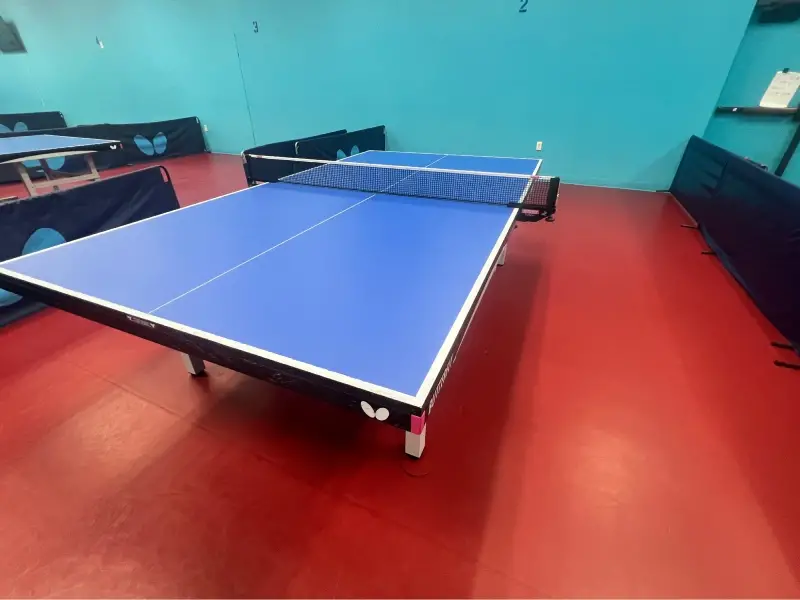
Butterfly backs the Octet 25 with a 5-year warranty, which is notably longer than the 1-3 year coverage most competitors offer. This warranty length reflects genuine confidence in the build quality, which is expected from Butterfly.
The construction quality matches what you’d expect from a table at this price point. It’s built for institutional use (clubs, training centers, schools) where equipment takes daily punishment. For home use, this table should last decades.
Storage and Portability
The two-piece rollaway design makes storage practical despite the table’s weight. Each half folds upright independently and rolls on four locking casters.
When the two halves are nested together for storage, the combined footprint is roughly 60″ long × 25″ deep × 61″ high. That 25-inch depth is genuinely compact for a tournament-grade table, though not quite as compact as the Space Saver 22.
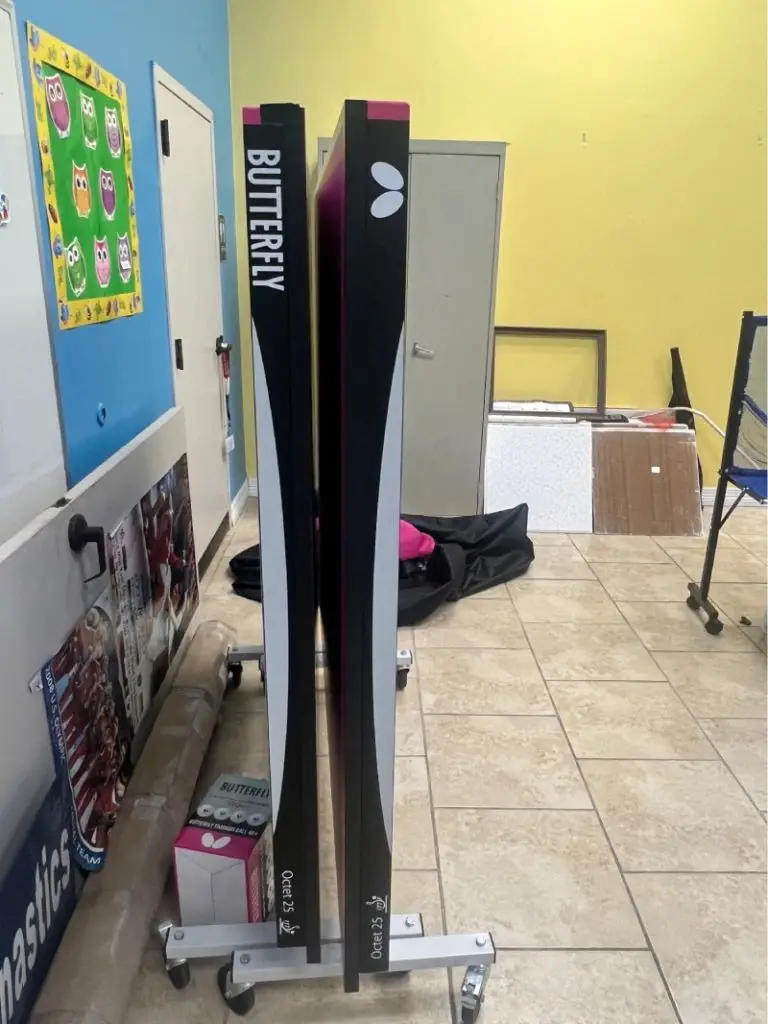
That being said, clubs can still definitely line up multiple Octets side-by-side without consuming excessive floor space.
Rolling the table on flat surfaces is straightforward. Once folded, one person can push each half easily. The 4-inch wheels roll smoothly on hard floors, and the brakes lock firmly when you need the table stationary. The safety latches automatically engage when you fold the table up, so there’s no risk of it unexpectedly unfolding during storage.
The weight becomes a factor when navigating tight spaces or stairs. At 138 lbs per half, you’ll want two people (ideally three) for any maneuvering beyond flat-ground rolling.
For clubs storing multiple tables, the Octet’s storage efficiency is a genuine advantage. The narrow profile when folded means you can pack several tables in a relatively small storage room. For home users with limited space, the ability to fold and roll the table against a wall makes it viable where a permanent setup wouldn’t be.
Value for Money
At roughly $2,100–$2,500, the Octet 25 sits squarely in premium territory. To put that in context you can buy recreational tables for $300–$600, or solid club-grade tables for $800–$1,200.
The price reflects what you’re getting. ITTF approval, 25mm playing surface with Perfect Grip coating, heavy-duty steel frame construction, and a 5-year warranty. It’s less expensive than Butterfly’s flagship Centrefold 25 ($2,500–$3,000) but costs significantly more than alternatives like the JOOLA Tour 2500 ($800–$1000).
Is the premium justified? That depends entirely on your use case.
For serious competitive players and clubs running regular training or tournaments, yes. The table delivers genuine tournament-grade performance that’ll hold up under daily use for years. The 5-year warranty versus 1-3 years on cheaper tables matters when you’re using equipment constantly. Over a decade of club use, you’re likely replacing cheaper tables once or twice while the Octet keeps performing.
For casual home players or recreational clubs, the value proposition weakens considerably. A table like the JOOLA Tour 2500 delivers 80-90% of the playing experience at a third of the cost. Unless you’re playing several times per week at an intermediate level or higher, that performance gap probably isn’t worth the $1,300+ difference.
The durability factor matters most for high-use scenarios. Home players putting 2-5 hours per week on a table won’t wear it out regardless of quality. Club environments with 20+ hours of weekly use are where the Octet’s build quality translates to lower long-term costs.
It’s premium equipment priced appropriately for what it delivers. Whether that represents good value depends on whether you genuinely need tournament-grade performance and durability.
Alternatives to the Octet 25

One-piece design, fully assembled, ultra-compact storage. Same playing surface, higher price, zero assembly required.
JOOLA Tour 2500

Similar 25mm two-piece design at one-third the cost. Good bounce, lighter build,
shorter warranty.

Mid-tier Butterfly option with 22mm top. Compact storage, solid club-grade performance, more affordable.
Final Verdict
The Butterfly Octet 25 delivers tournament-grade performance in a practical two-piece format. The 25mm Perfect Grip surface provides genuinely professional bounce quality, and the build is substantial enough to handle years of intensive club use without degradation.
After testing extensively in a club environment over five years, the table performed exactly as it should from day one through to now.
The weaknesses are pretty straightforward. It’s heavy (plan on 2-3 people for initial setup), and expensive ($2,100-$2,500). It’s strictly indoor use, and the weight makes casual relocation impractical.
This table makes sense for serious competitive players, clubs running regular training or tournaments, and committed home players who’ll use it frequently. The performance justifies the investment in those scenarios. For casual recreational use, you’re paying for capabilities you won’t fully utilize, where cheaper alternatives deliver sufficient quality at a fraction of the cost.
If you fit the target profile and can manage the initial setup, the Octet 25 is among the best tables you can buy at this price point. It’s not perfect (nothing at this weight is truly portable), but it executes its core purpose without compromise.
Who Should Buy This?
- Dedicated tournament players: Serious athletes training for high-level competition will appreciate the bounce and consistency.
- Clubs and training facilities: Any club needing a competition-quality table (that can be stored compactly) will find the Octet an excellent long-term asset.
- Institutions and organizations: Schools or sports centers that run leagues or clinics will value the durability.
Skip this table if:
- You’re a casual player or beginner who mostly plays for fun. A sub-$1,000 table will suffice.
- You need extreme portability or outdoor use (the Octet is heavy and indoor only).
- You have a tight budget (consider the JOOLA Tour 2500 or similar for much lower cost).
- You truly can’t manage moving a 275-lb table even with assistance, a lighter model might be better.
For someone who fits the Octet’s profile, it’s a long-term investment in your game. The playing surface is essentially “pro stock” and should outlast multiple cheaper tables.
This review was supported by contributions from Racket Insight community member A. Adame. We thank them for making sure this is the most accurate and in-depth review of the Butterfly Aspire table available anywhere.

David's been playing Table Tennis since he was 12, earning his first coaching license in 2012. He's played in national team & individual competitions, although he prefers the more relaxed nature of a local league match! After earning his umpiring qualification in England, David moved to Australia and started Racket Insight to share information about the sport he loves.
Blade: Stiga WRB Offensive Classic | Forehand: Calibra LT | Backhand: Xiom Musa
Playstyle: The All-Rounder