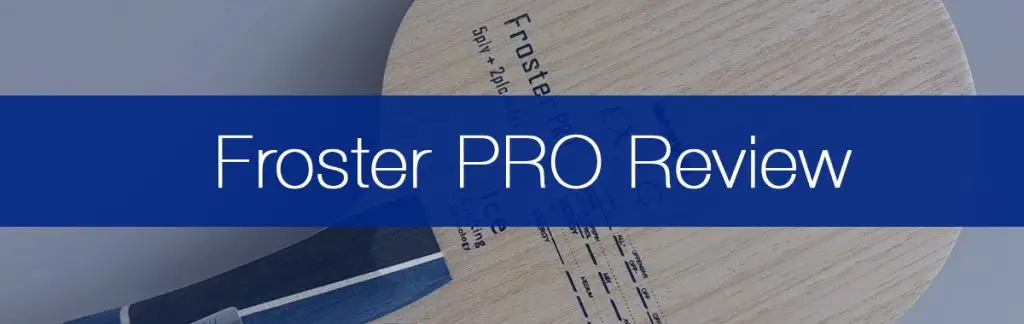
Chinese blade manufacturers have made enormous progress over the past few years, and Sanwei’s Froster lineup is a good example of that shift. Rather than chasing extreme speed or novelty materials, the Froster series focuses on controlled offensive play built around modern looping mechanics.
I previously reviewed the Sanwei Froster EX-C in depth. The PRO EX-C is closely related, sharing the same foundation, so this review is not a ground-up re-test of the concept. Instead, the goal here is to understand what the PRO version changes, how it plays relative to the standard EX-C, and who it actually makes sense for.
Sanwei provided the Froster PRO EX-C for review at no cost. As always, that has no bearing on my assessment, which reflects independent testing and honest evaluation.
Compared to the EX-C, the PRO Ex-C feels more direct on contact. Dwell time is still present, but shorter and cleaner, which makes counter-looping and higher-tempo rallies feel more controlled and predictable. The blade stays stable when you swing hard and rewards committed strokes with consistent depth and pace.
There are still limitations. The short game remains lively and requires good hands to keep the ball short. While speed is improved over the EX-C, it still falls short of true power blades like Viscaria or PBO-style composites. Players who rely heavily on flat hits or constant variation may still find it restrictive.
At its price point, the Froster PRO Ex-C offers strong build quality and great performance. It is not a replacement for the EX-C, but a logical step for players who like the Froster feel and want more firmness and stability without jumping to a much stiffer blade.
Recommended For: Intermediate to advanced loopers who like the Froster EX-C concept but want a firmer, more stable response for faster rallies and more aggressive counter-looping.
Recommended
About the Reviewer

David brings 20 years experience as a player, with 10 of those coaching players of all ages and standards. His style is The All-Rounder
About the Review
Forehand Rubber: Sanwei Target National
Backhand Rubber: Sanwei Gear Hyper
Hours Tested: 10+
Test Levels: Intermediate to Advanced Training & Matches
Understanding the Froster Lineup
The Froster series is best understood as a single ‘design philosophy’ expressed through different levels of stiffness, speed, and feedback.
It annoys me that the names are so similar, as it’s taken me a while to get to grips with the difference between each option. Hopefully I can make it easier for you to understand!
All Froster blades are built for looping first. They prioritise arc, dwell time, and rally consistency over flat speed and close-to-table punch. Where they differ is how aggressively the composite layers engage, how rigid the structure becomes at higher impact, and how much margin for error the blade offers under pressure.
The Sanwei Froster EX-C is the most forgiving model in the range. Its Arylate-carbon construction produces a medium dwell time, a medium-high arc, and excellent control during spin exchanges. Power delivery is linear and predictable, which makes it especially appealing to intermediate and advanced loopers who value consistency and safety during rallies.
The Sanwei Froster PBO sits at the opposite end of the spectrum. By using PBO fibre instead of ALC-based composites, it significantly increases stiffness, rebound speed, and structural rigidity. The result is a heavier, faster blade with a higher power ceiling, but reduced dwell time and forgiveness. It is designed for experienced players who want direct response and stability at high speed rather than built-in control.
The Sanwei Froster PRO EX-C occupies the space between those two approaches. It does not retain the ALC structure of the regular EX-C. Instead, it replaces ALC with PLC (Polyarylate Carbon Fiber), which is designed to add speed and increase stability without reaching the rigidity of PBO.

I was excited to get my hands on it to see how that PLC layer changes the characteristics of the Froster blade.
Build Quality and Design
The Froster PRO EX-C uses a 5+2 outer-fiber construction, a format that has defined modern offensive blades for years. As discussed, the key difference lies in the composite layer itself.
Instead of Arylate Carbon, the PRO EX-C uses a Japanes-made PLC (Polyarylate Carbon Fiber).

PLC is designed to provide a more consistent energy return and clearer vibration feedback than traditional ALC, while avoiding the extreme rigidity associated with PBO or Zylon-based fibers.
In practice, this results in a blade that feels firmer and more composed than the standard EX-C, without crossing into harsh or overly stiff territory.

The blade thickness remains in typical outer-fiber territory, and weight stays closer to the EX-C than the heavier PBO. Balance is neutral, and the blade feels well assembled, with clean ply transitions, smooth edges, and no visible finishing issues.

Build quality is solid and easily comparable to higher-priced European composite blades.
On-Table Performance
Speed and power delivery
The Froster PRO EX-C is faster than the standard EX-C, but I personally found the increase is controlled rather than dramatic.
The difference shows up most clearly when you swing with intent. The blade accelerates more decisively through the ball, especially during counter-looping and open rallies. The power feels firmer and more connected, with less flex at higher impact.
Importantly, the speed increase comes without any trampoline effect. There is no sudden catapult. The blade responds proportionally to input, which keeps it predictable during fast exchanges.
Flat hitting still is not its strength. Like the rest of the Froster line, the PRO EX-C wants to be used with spin and proper stroke mechanics.
Spin, arc, and dwell
Spin generation remains a core strength.
The arc is slightly lower and more defined than the EX-C, but still clearly in the medium to medium-high range. The blade still holds the ball long enough for strong spin, yet I felt that the PLC fiber releases it a touch faster, which makes placement feel crisper and more precise.
This should give aggressive loopers more confidence when increasing pace, particularly from mid-distance, without sacrificing consistency.
Stability and feedback
This is where the PRO EX-C clearly separates itself from the standard EX-C.
The blade feels more stable during high-impact rallies and counter-loops. Feedback is clearer and more informative, with reduced mushiness at contact. You feel the ball compress and release cleanly, which helps with timing and angle adjustment during fast exchanges.
Vibration is present but controlled. The blade never feels dead, but it also does not buzz or resonate unnecessarily.
Short game and touch
The short game remains a relative weakness.
While the PRO EX-C feels slightly more controlled than the EX-C due to its firmer structure, it still has a lively rebound compared to softer ALC blades or all-wood options. Serves and short pushes require intent and good hands to keep the ball low.
Flicks and active receives work well because you are engaging the blade. Passive touch play is less forgiving.

- Construction: 5+2 (5 wood plies + 2 PLC fiber layers)
- Outer Plies: Koto hardwood
- Core: Ayous (Kiri wood)
- Thickness: ~5.7mm
- Weight: ~88g ±5g (varies by individual blade)
- Speed Category: OFF
- Handle Types: Flared, Straight, Chinese Penhold
Summary: A high-performance offensive ALC blade that blends explosive pace with clear feedback and strong spin control, giving advanced players a balanced feel between power and precision.
PRO EX-C vs Standard Froster EX-C
The difference between these two blades is refinement, not reinvention.
If you liked the EX-C for its arc, spin, and control, the PRO will feel immediately familiar. The main change is a slightly firmer, more composed feel at higher impact, particularly during counter-looping.
The PRO does not transform the blade into a versatile weapon. It simply tightens the response, increases the speed slightly and gives confident loopers a bit more presence without pushing them into the stiffer, heavier feel of the PBO.
Froster PRO EX-C vs Butterfly Viscaria
If you’ve played with a Viscaria before, the comparison is pretty straightforward.
The Viscaria is a bit faster and more direct, especially on hard counters and flat hits. The ball comes off quickly and rewards early timing and confident swings.
The Froster PRO EX-C is slightly slower at the very top end, but it feels easier to control when you are looping under pressure or playing longer rallies. Speed builds more smoothly rather than jumping off the blade.
Where the Froster PRO really holds its own is in feel and spin control. You get clearer feedback in the hand and a bit more dwell, which makes it easier to load topspin and shape the ball without forcing your stroke.
Viscaria is still the pick if you want maximum punch and simplicity, but if you like a touch more safety, clearer feedback, and a blade that helps you stay consistent when rallies get fast, the Froster PRO Ex-C is a very believable alternative at a lower price point.
Who should choose the Froster PRO EX-C?
The PRO EX-C makes sense for players who already like ALC blades and want a controlled offensive setup with a bit more authority during spin exchanges.
It suits:
- Intermediate to advanced loopers who play primarily with topspin
- Players who liked the regular Froster EX-C but want a slightly firmer, more direct response
- Those who value rally consistency over raw finishing speed
It is less suitable for:
- Flat hitters and close-to-table punch players
- Players who rely heavily on short game touch
- Anyone expecting a major speed upgrade over the EX-C
Verdict: Upgrade, Sidegrade, or Alternative?
The Froster PRO EX-C is a sidegrade with intent.
It does not replace the standard EX-C, nor does it compete directly with the PBO. Instead, it offers a more dialled-in ALC experience for players who want a touch more stability and presence while preserving the Froster line’s core strengths.
If you already own the EX-C and are happy with it, there is no urgent reason to switch. If you are choosing between the two for the first time, the PRO EX-C makes sense for slightly more aggressive loopers who still value control.
In the context of Sanwei’s lineup, the PRO EX-C fills a sensible gap. It stays true to the Froster identity and avoids chasing speed at the expense of playability, which is exactly what this series does best.

Alvaro’s a qualified ITTF Level 1 Coach who's been playing Table Tennis since he was 15 and is now ranked within the top 50 in his native Argentina. He loves to compete in provincial tournaments and is always looking for ways to improve. Alvaro made his favorite memories with a racket in hand, and he joined the RacketInsight team to share his passion with other players!
Blade: Butterfly Fan Zhendong ALC | Forehand: Butterfly Dignics 09c | Backhand: Butterfly Tenergy 19
Playstyle: The Controller