70% of players I coach are using the wrong blade type.
Just last week, I watched a player lose match after match because his carbon blade kept firing balls long. His opponent? Dominating with an all-wood blade that actually matched his skill level.
Choosing between all-wood and carbon isn’t about speed versus control. It’s about matching your blade to where you are right now as a player – not where you think you should be.
Get this decision wrong, and you’ll potentially plateau for months. Get it right, and you’ll immediately start winning more matches.
After reading this article, you can also check out our best table tennis blades article to help pick a specific blade. Let’s begin!
What Are All-Wood Blades?
All-wood blades, as the name suggests, are blades composed of only natural wood plies. They have one or more types of woods layered in different ways to achieve different results (more control, more speed, a specific feeling, etc).
All-wood blades are usually either 1-ply (most commonly 1-ply Hinoki, less so 1-ply Ayous blades), 5-ply, or 7-ply.
Even if all-wood blades come in all shapes and forms, most all-wood blades share similar advantages and disadvantages.
Starting with their key advantages, good all-wood blades have:
- A great feeling, that is, the wood feels “alive”; you can feel the vibration of the wood and the feedback in your hand, depending on how you hit the ball (whether it’s a well-hit shot or an off-center strike).
- More flexibility, which allows for easier spin production and a higher, safer throw angle.
- A longer dwell time with the ball, which enables a higher sense of control.
However, they also have their disadvantages:
- Less stability and directness when playing at high speeds.
- Less attacking potential.
- More sensitivity to incoming spin.
Because of their traits, all-wood blades are great choices for basically every player except for intermediate or advanced offensive players who want the extra firepower and stability that carbon layers bring to the table.
There is one slight caveat to our definition of All-Wood blades. Butterfly has developed a material called Cellulose Nano Fiber (CNF), made from wood, but, as it’s not regular wood, it’s considered a composite.
What Are Carbon Blades?
Carbon blades take a different approach than all-wood blades. While they’re still mostly wood (ITTF rules require at least 85% natural wood by thickness), they include 1-2 thin layers of composite materials.
That remaining 15% might sound small, but these composite layers completely transform how the blade plays. Think of them as performance boosters that amplify power and stability while changing the feel entirely.
The most common composites you’ll encounter are carbon fiber, arylate-carbon (ALC), zylon-carbon (ZLC), kevlar carbon, and glass fiber. If you want to dive deeper into the differences between ALC and ZLC specifically, we’ve written an article comparing ALC with ZLC blades.
These composites act as reinforcements to the wooden plies and greatly affect the feeling, vibration, stiffness, hardness, sweet spot, speed, and control of the blades.
Starting with their key advantages, good carbon blades have:
- Much larger sweet spots, that is, what would be an off-center, low-quality shot with an all-wood blade, can be a good shot with a composite blade.
- They’re usually faster and more powerful than all-wood blades.
- They’re stiffer and harder, which makes them play much more directly and precisely.
- They’re more insensitive to incoming spins, which makes them better for countering.
However, like all-wood blades, carbon blades also have their disadvantages:
- Less control for inexperienced players: carbon blades with their lower throw, lesser feedback, and higher speeds can be unforgiving for lower-level players.
- It’s harder to generate spin due to their relatively low flexibility.
Carbon blades are the ideal choice for attacking players who already know the techniques of the sport and want the extra offensive potential these blades can offer.
All-Wood vs Carbon: Direct Comparison
We have created a comparison chart for you to visualize the differences between all-wood and carbon blades:
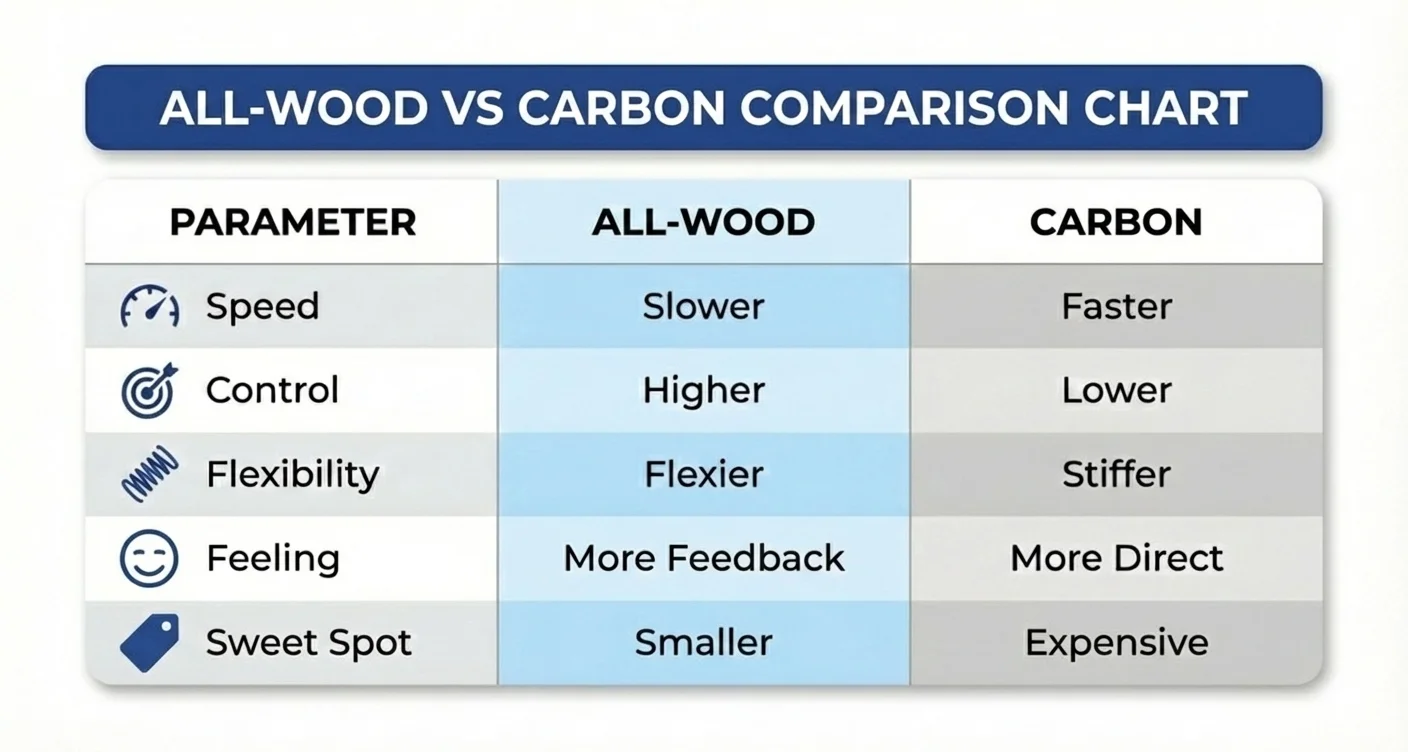
Of course, this chart is an oversimplification, as there can be all-wood blades that are faster or more expensive than composite blades, but we tried to paint the big picture.
All-wood
In general, all-wood blades are slower but have more control.
They’re flexier, which means they generate a predictable parabola and a higher throw, which makes them easier to play, but harder to hit outright winners with.
Also, because they’re flexier, it makes it easier to generate spin, but they’re also more sensitive to incoming spin, making it harder to counterloop or punch through spin.
Finally, all-wood blades tend to be cheaper than carbon blades, but this is not always the case.
Carbon
In general, composite blades are faster but have lower control.
They’re stiffer, which means they’re more direct and lower throwing, which makes it better for playing fast winners, but this effect also comes with a lesser margin for error.
Also, because they’re stiffer, it makes it harder to generate spin, but they’re also more insensitive to incoming spin, making it easier to counterloop or punch through spin.
Finally, carbon blades tend to be more expensive than all-wood blades, but this is not always the case.
Which Blade Should You Choose?
Based on all we mentioned above, we firmly believe that you should choose:
All-wood
Beginners should choose all-wood blades. The safety and ease of spin generation of all-wood blades is perfect for learning and perfecting all the techniques of the sport.
Defensive players and all-rounders also tend to prefer all-wood blades, for the same reasons (combo of feeling, safety, and control).
Intermediate offensive players can choose either all-wood or carbon, depending on their personal preferences, their consistency, and how much they train.
If you’re an intermediate offensive player and:
- You prefer the ease of spin generation of all-wood blades, or,
- You like the feeling of all-wood blades, or,
- You don’t train that seriously, and you already have an all-wood blade
Then all-wood blades are a perfectly fine choice.
Even some advanced-level offensive players choose all-wood over carbon because of these very same reasons (though they’re a minority).

Carbon
If you’re an intermediate offensive player and you train a lot, you take table tennis seriously, and you see yourself playing for many more years, I recommend you pick a carbon blade.
Why?
You’ll have to do it at some point, regardless, so if you already know how to loop and you’re consistent, you can definitely switch to carbon earlier to start getting used to it.
If you’re an advanced offensive player, I recommend carbon blades because they’re more direct, stable, have a larger sweet spot, and they’re better for powerlooping and countering.
However, it’s okay to experiment. You may prefer the feel of all-wood blades, and that’s also perfectly fine.
Making Your Final Decision
Remember that player I mentioned at the start? After switching from carbon to an all-wood blade that matched his current skill level, he won his next three matches. The difference wasn’t having “better” equipment, it was simply using the right equipment for where he was as a player.
Here’s what I tell every player I coach: Your blade should enhance your strengths, not expose your weaknesses.
If you’re still developing consistent technique and learning to generate spin, all-wood blades will give you the feedback and control you need to improve. If you’ve mastered the fundamentals and want to add power to your attacking game, carbon blades can take you to the next level.
The biggest mistake? Rushing into carbon because you think it makes you a better player. Equipment doesn’t create skill, it amplifies what you already have.
Ready to find your perfect blade? Check out our best table tennis blades article for specific recommendations, or dive deeper with our complete blade selection guide.

Alvaro’s a qualified ITTF Level 1 Coach who's been playing Table Tennis since he was 15 and is now ranked within the top 50 in his native Argentina. He loves to compete in provincial tournaments and is always looking for ways to improve. Alvaro made his favorite memories with a racket in hand, and he joined the RacketInsight team to share his passion with other players!
Blade: Butterfly Fan Zhendong ALC | Forehand: Butterfly Dignics 09c | Backhand: Butterfly Tenergy 19
Playstyle: The Controller