Speed, spin, and control rubber ratings are completely useless, and there are several better ways to tell how a given rubber plays.
In this article, we’ll challenge the perception that manufacturer rubber ratings are useful, simply because they’re not. Quite the opposite, rubber ratings are misleading and dangerous for the development of the players who take table tennis seriously.
Hence, in this article, we’ll explain why this is, and the better ways and resources to understand how a rubber plays without needing to try it yourself.
The Problem with Rubber Ratings
In short, the main problem with this type of rubber ratings is that there’s no universal standard; that is to say, each brand uses its own scale.
Because each table tennis brand uses a different scale, you can’t compare rubbers from different brands based on the numbers they use to rate their rubbers.
Let’s take a look at a real example to understand our point: we’ll choose the Yasaka Rakza 7 and the Butterfly Tenergy 05.
We’ve reviewed both, and, in addition to that, I have personally used the Rakza 7 for 2-3 years and the Tenergy 05 for half a year, so I know exactly how they play.
The Yasaka Rakza 7 is the perfect rubber for beginner offensive players, as it has moderate speed and spin and great control for an offensive rubber.
I would say that the Rakza 7 is an all-round offensive rubber, much more geared towards control than to speed or spin.
In turn, the Butterfly Tenergy 05 is an absolute weapon of a rubber. We recommend it to advanced offensive players because of how fast, explosive, and spinny it is.
The Tenergy 05 is an ultra-offensive rubber that was and is still used by professional players around the world.
Side by side, the Tenergy 05 is much, much faster and spinnier than the Rakza 7; there’s no point in comparing them due to how far ahead the Tenergy is in terms of performance. The difference is night and day.
However, the Rakza is better for beginners due to its added control (because of it being much slower than the Tenergy 05).
Now, let’s take a look at the manufacturer’s ratings for both these rubbers:
Yasaka Rakza 7
Butterfly Tenergy 05

Comparison
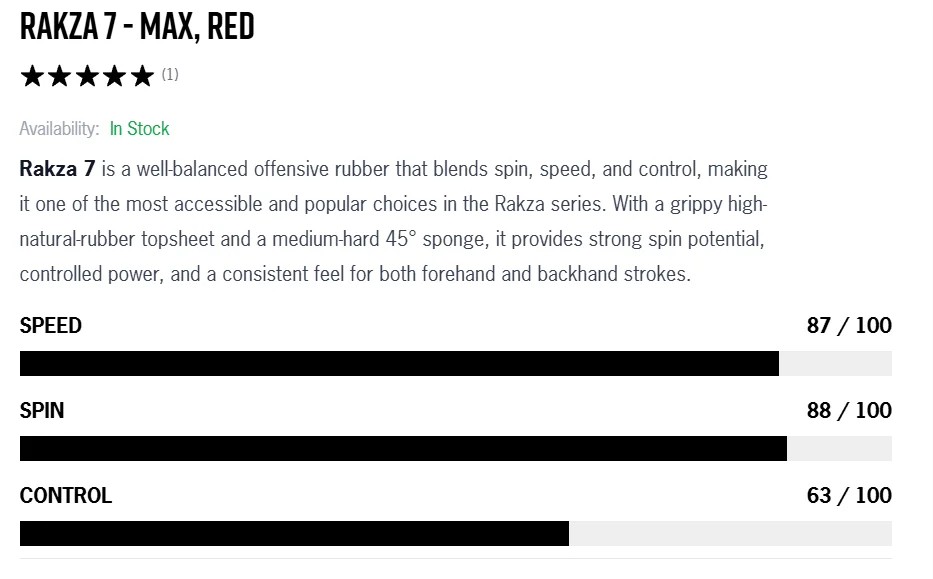
Yasaka scores their Rakza 87 for speed, 88 for spin, and 63 for control.
Butterfly scores their Tenergy 83 for speed (4 less than the Rakza), 76 for spin (12 less than the Rakza), and they don’t score for control.
Someone who doesn’t know better may think from these numbers that the Rakza would be the faster and spinnier rubber, and they couldn’t be farther from the truth.
Also, another thing to look at is that Yasaka rates their Rakza 45° for hardness, against the Tenergy’s 36°. This is also hugely misleading, as the Tenergy is the harder rubber of the two.
If you want to understand why this is, please refer to our rubber hardness guide.
Other Problems with Rubber Ratings
As if that wasn’t enough, there are other problems with rubber ratings, such as some rubber manufacturers rating their rubbers outside a 1-10 or a 1-100 range.
For example, Nittaku rates their excellent Hammond Z2 16 for speed and 13 for spin.
Finally, another problem is that some manufacturers will exaggerate their ratings; that is, they’ll score all their rubbers 9+ in terms of speed and or spin.
If we think about this logically, rubbers with a 9 speed/spin rating should be above average in terms of these characteristics.
However, no manufacturer will rate their rubbers 5-6 in terms of speed and spin because this would be terrible marketing.
The effect this produces is that all the rubbers end up being 8+ in terms of speed and spin, which is completely unrealistic, as there are very significant differences between rubbers.
Better Ways to Choose a Rubber
Read independent reviews
If you have to choose a rubber without being able to try it in person, the best thing you can do is to read an independent review by a trusted source.
Independent reviews are great because what the reviewer states about the rubber is honest – they aren’t influenced by manufacturers in any way to say one thing or the other.
In addition, independent reviewers will also try to contextualize each rubber they review by comparing it to similar offerings.
At Racket Insight, we have reviewed dozens of rubbers, and we always try to compare rubbers with one another so that you can get the perfect idea of how exactly they play. If you want to read our reviews, here’s the link to our rubber reviews library, containing all of them.
We’ve also written a comprehensive guide to choosing a table tennis rubber if you don’t know where to begin.
Our goal is for you to understand who the rubber is for, who it isn’t for, what it brings to the table, and what it lacks.
Manufacturers will only say good things about their rubbers. However, they’ll skip the negative parts, or the aspects in which their rubbers are outshone by other offerings.
Because we’re independent, we can always tell you if we think another rubber is outright better for a given use case, like we did with the Tibhar Hybrid K3 (we believe the Andro Rasanter C53 is simply better for all players).
Test in person
Nothing beats testing any piece of equipment in person.
Even though independent reviewers may convey how a rubber plays correctly, your experience may just be different, or you may gravitate towards a certain style of rubber more than the reviewer.
For example, if you ask me, I would never use the Nittaku Fastarc G-1. I have reviewed it and I mentioned that it’s a great rubber, and that’s because it is.
It has great speed and spin, good control, a safe, high arc, and endless durability. It’s probably the best price-performance rubber you can get. But I don’t like it.
I don’t like it because I dislike its feel, and I don’t understand it.
I feel like I sometimes overshoot the table for no reason, and I find it hard to adjust to it, but the vast majority of players who play with the Fastarc don’t have this issue. It’s just a personal thing with me.
So, try your best to try all the rubbers you can. If you want to change rubbers, ask all your clubmates to try out their rackets, and try both the forehand and backhand rubbers.
This will give you the best idea of what you like and dislike.
What Ratings Can Tell You (Barely)
However, rubber ratings can be somewhat useful if you put them into context, that is, if you compare rubbers from the same brand.
For most brands, they will have an internal structure for scoring their rubbers that is actually comparable for rubbers within the brand.
Butterfly’s way of comparing is a trustworthy one, for example, as they use objective measurements such as shot trajectory, spin rate, rebound speed, etc. For other manufacturers, this is not the case, but you’d have to check brand by brand.
Something many manufacturers get right is when they describe their rubbers using words rather than numbers.
Instead of using inflated numbers, their descriptions many times match what the actual product is.
Coming back to the Rakza 7 example, let’s analyze Yasaka’s description of their popular offering:
“Rakza 7 is a well-balanced offensive rubber that blends spin, speed, and control, making it one of the most accessible and popular choices in the Rakza series.
With a grippy high-natural-rubber topsheet and a medium-hard 45° sponge, it provides strong spin potential, controlled power, and a consistent feel for both forehand and backhand strokes.”
So what they’re basically saying is that it’s a controllable and easy-to-use offensive rubber, which is exactly the case.
However, their ratings for the Rakza 7 in numbers, like we saw before, are these:

This doesn’t coincide with their description at all, which was quite accurate. The numbers they provided are more akin to a very offensive, high-tech rubber.
Hence, my advice is that, if you have to choose what to trust, always prioritize, in this order:
- Your own testing experience.
- Trustworthy independent reviews.
- Objective ratings based on real metrics (if present, most times not present).
- Manufacturer’s description (sometimes accurate, others not at all).
- Manufacturer’s subjective number ratings (most times, completely useless).
Conclusion
To sum up, speed-spin-control ratings are almost always mere marketing tools, not real data.
If you want to understand how a rubber plays, please refer to the actually useful resources you should take a look at, such as our rubber reviews library, containing reviews of all the most popular rubbers.
In addition, we’ve written a best table tennis rubbers article, sharing our top rubber picks and providing alternatives and comparisons for each of our picks.

Alvaro’s a qualified ITTF Level 1 Coach who's been playing Table Tennis since he was 15 and is now ranked within the top 50 in his native Argentina. He loves to compete in provincial tournaments and is always looking for ways to improve. Alvaro made his favorite memories with a racket in hand, and he joined the RacketInsight team to share his passion with other players!
Blade: Butterfly Fan Zhendong ALC | Forehand: Butterfly Dignics 09c | Backhand: Butterfly Tenergy 19
Playstyle: The Controller