Most flat attackers hit a ceiling on all-wood blades before they hit a ceiling on their technique. You’re landing drives cleanly, smashing well, dominating close-to-table, but the blade tops out before you do. Carbon gets you the pace but kills the feel you’ve spent years building. So where do you go?
Sanwei thinks it has the answer: basalt fiber.
A volcanic-rock composite that sits between wood and carbon in speed but much closer to wood in feel. The Surge Breeze is a 5+2 outer basalt blade priced at $40, and it’s the only blade on the market bringing this technology to that price point.
I tested the Breeze to find out whether it genuinely delivers or whether the basalt story is just good marketing.
Sanwei provided the Surge Breeze for review at no cost. As always, that has no bearing on my assessment, which reflects independent testing and honest evaluation.
Its defining strength is the combination of composite speed and basalt comfort. The outer basalt fiber adds crispness and punch that outpaces any all-wood at this price, while genuinely dampening the harshness you’d normally expect from a stiff outer-fiber construction. The low trajectory rewards early-ball aggression and committed hitting.
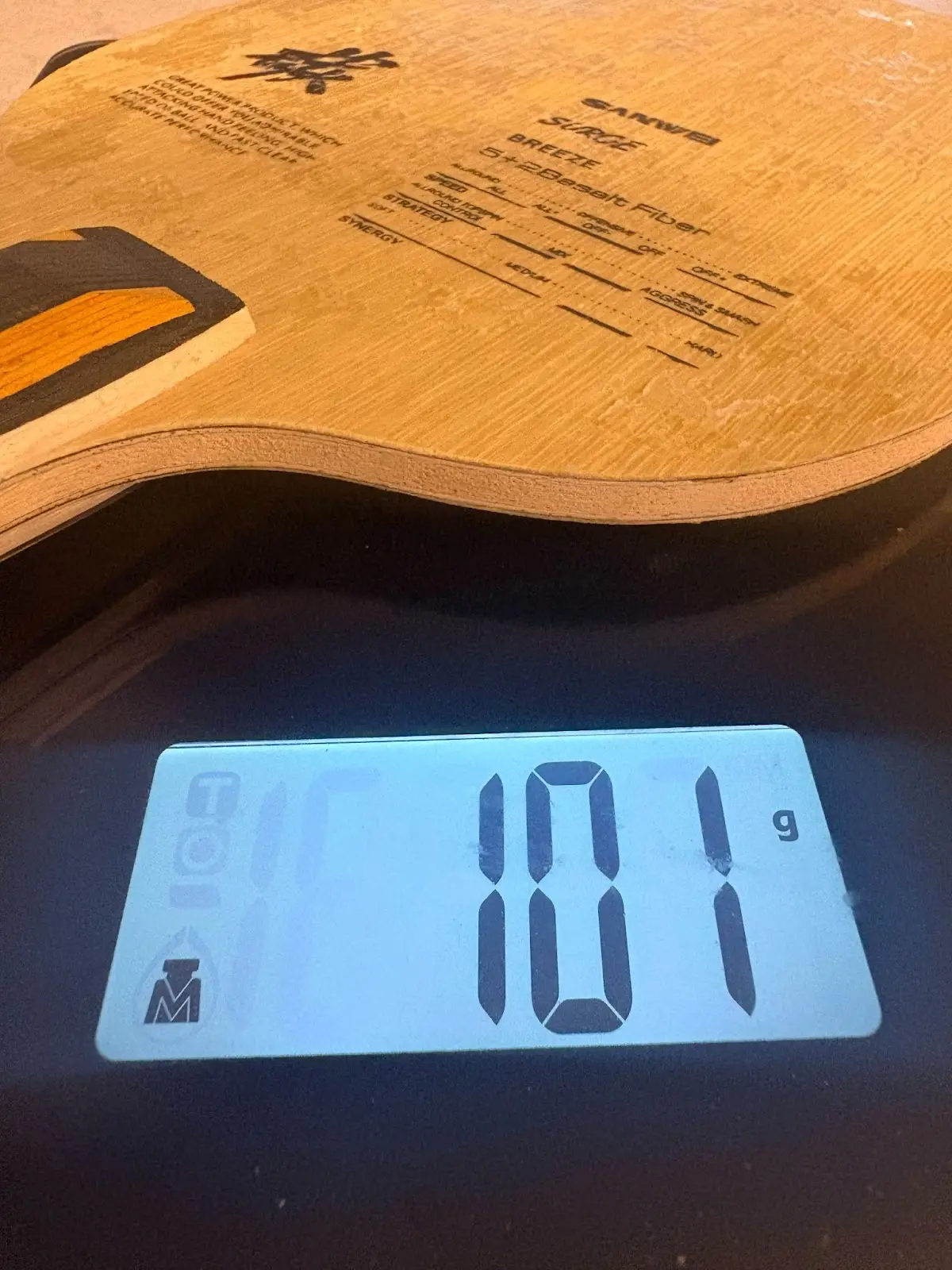
There is one fact that must lead any honest assessment. My sample weighed 101g bare, already at the extreme top of the warned variation range (90 to 104g). That is heavy by any standard and it significantly shapes the user experience. Pair it with rubbers and you’re looking at a 200g+ assembled racket.
Recommended For: Intermediate to advanced close-to-table attackers (3 to 8+ years) whose game is built on flat drives, early-ball aggression, and smashing, and who can accommodate a heavy setup. Players stepping up from all-wood who want composite pace without the arm punishment of carbon.
Recommended
About the Reviewer

David brings 20 years experience as a player, with 10 of those coaching players of all ages and standards. His style is The All-Rounder
About the Review
Forehand Rubber: Sanwei Target National
Backhand Rubber: Sanwei Target National
Hours Tested: 10+
Test Levels: Intermediate to Advanced Training & Matches
Recommended Playstyles
Flat-first attackers and close-to-table players who prioritise direct ball trajectories, early timing, and committed drives over topspin consistency and high-arc safety margins.


Design of the Sanwei Surge Breeze
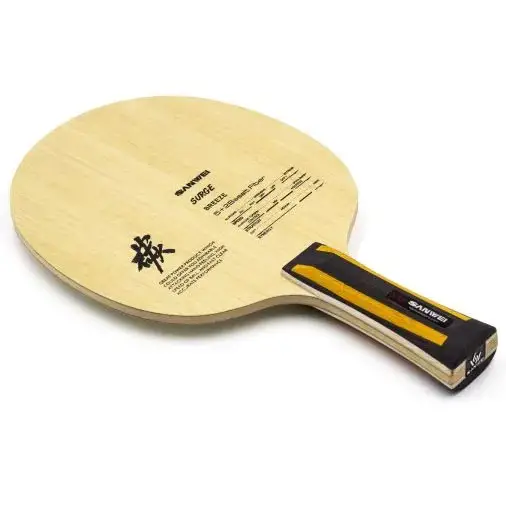
The Breeze has a cleaner, more premium look than its $40 price implies.
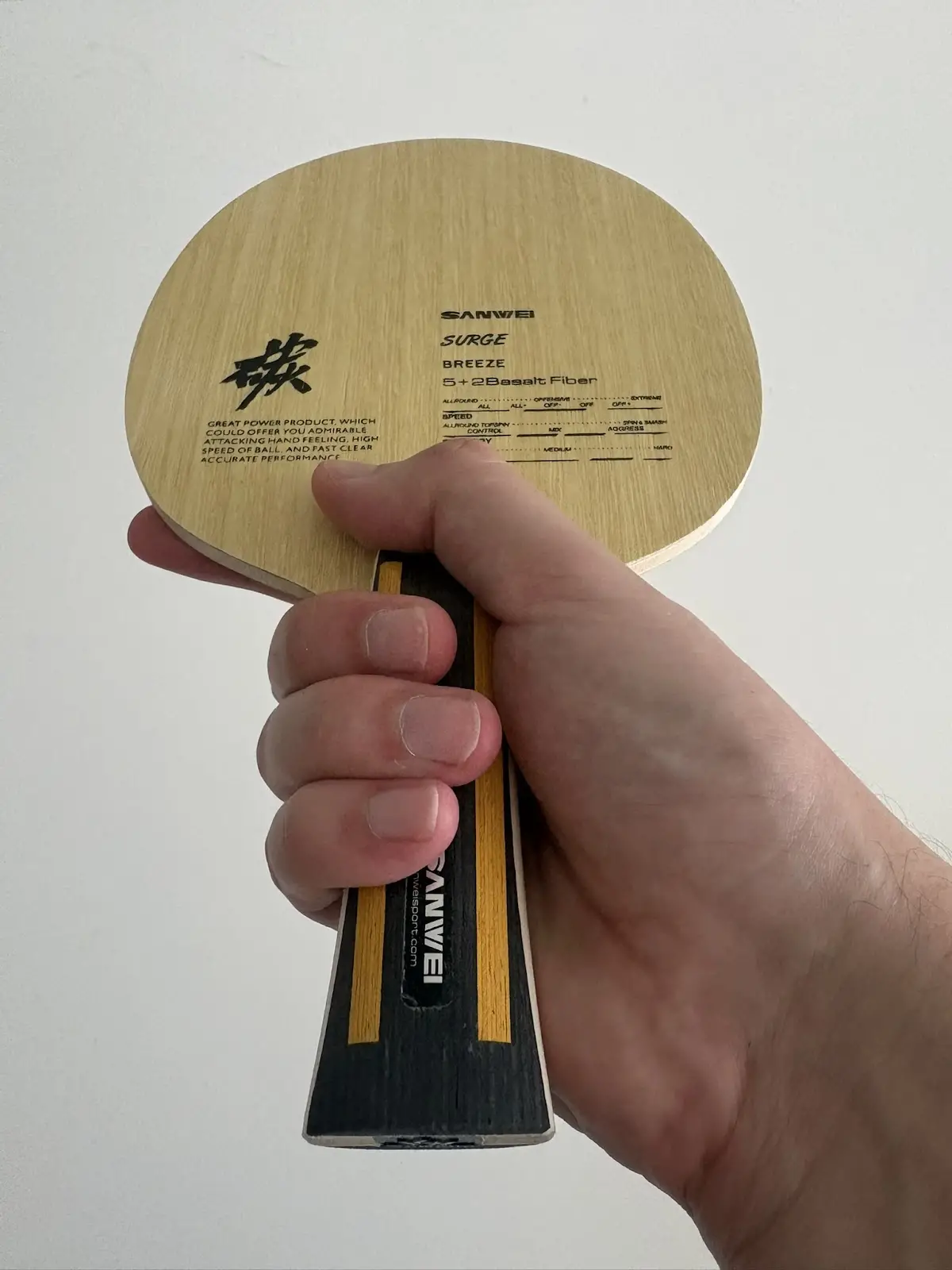
The blade face features smooth, light-coloured limba grain with understated branding, including a Chinese character (meaning carbon/basalt) as the decorative centrepiece.
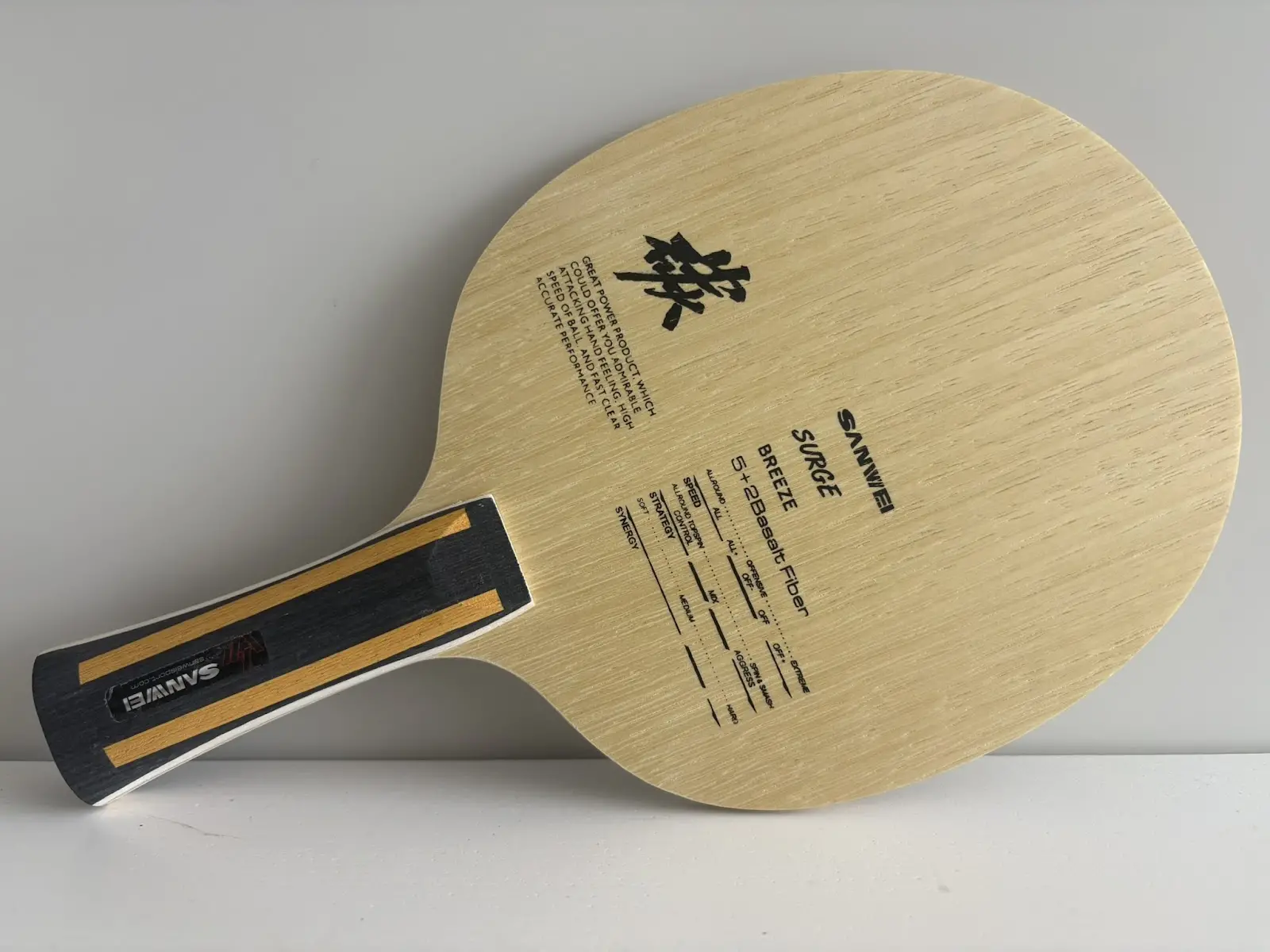
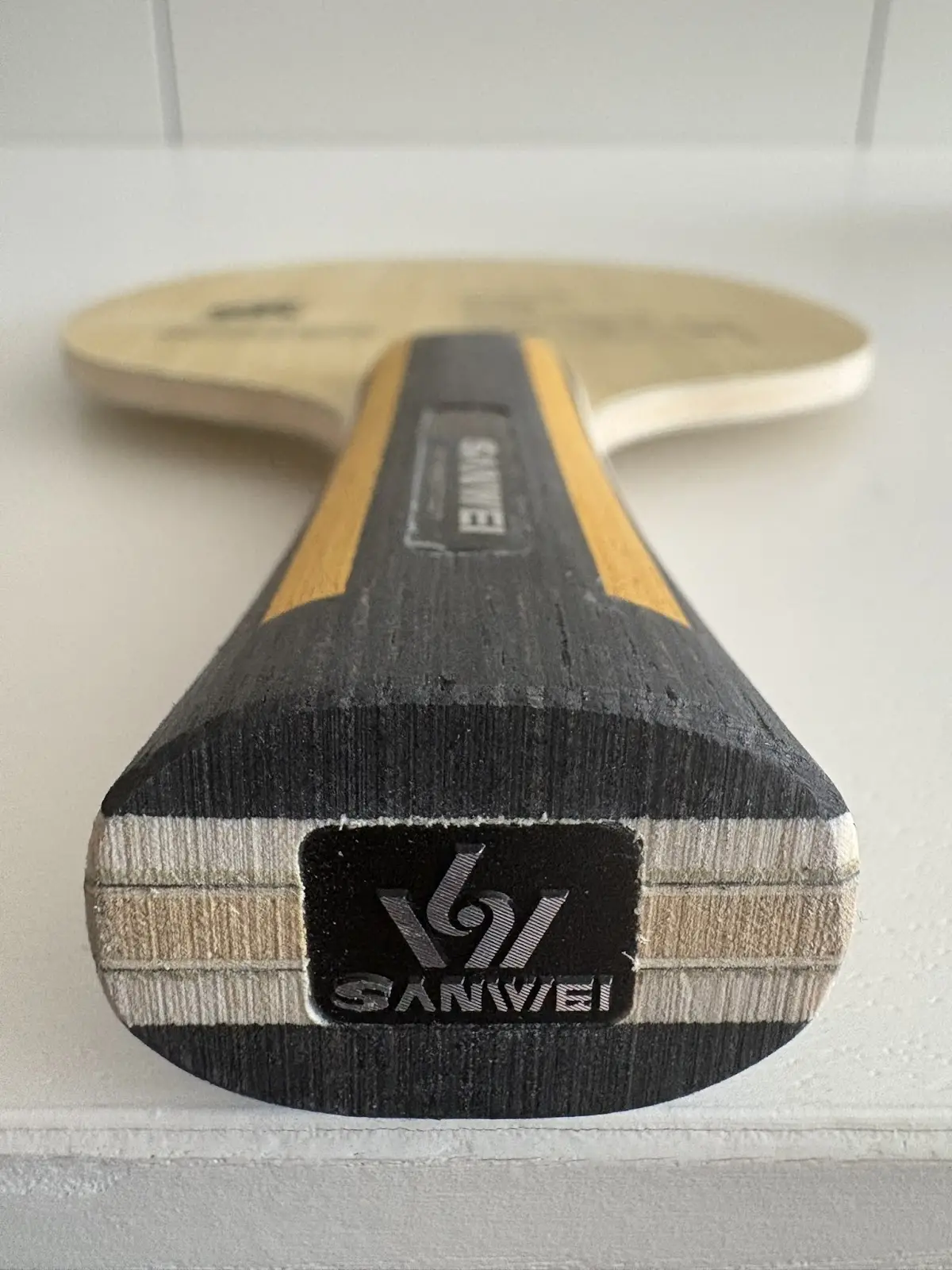
The handle is the standout visual element. A dark carbon-weave outer shell is broken by a prominent gold/amber timber accent stripe running down the centre, and the finish is notably well-executed for budget pricing. The end cap carries an embossed Sanwei logo inlay.
In the hand, the handle feels natural and well-proportioned. Players with larger hands will find it particularly well-suited. It has a slightly fuller feel than most other blades but nothing that would cause discomfort or require adjustment for most players.
Construction Specifics
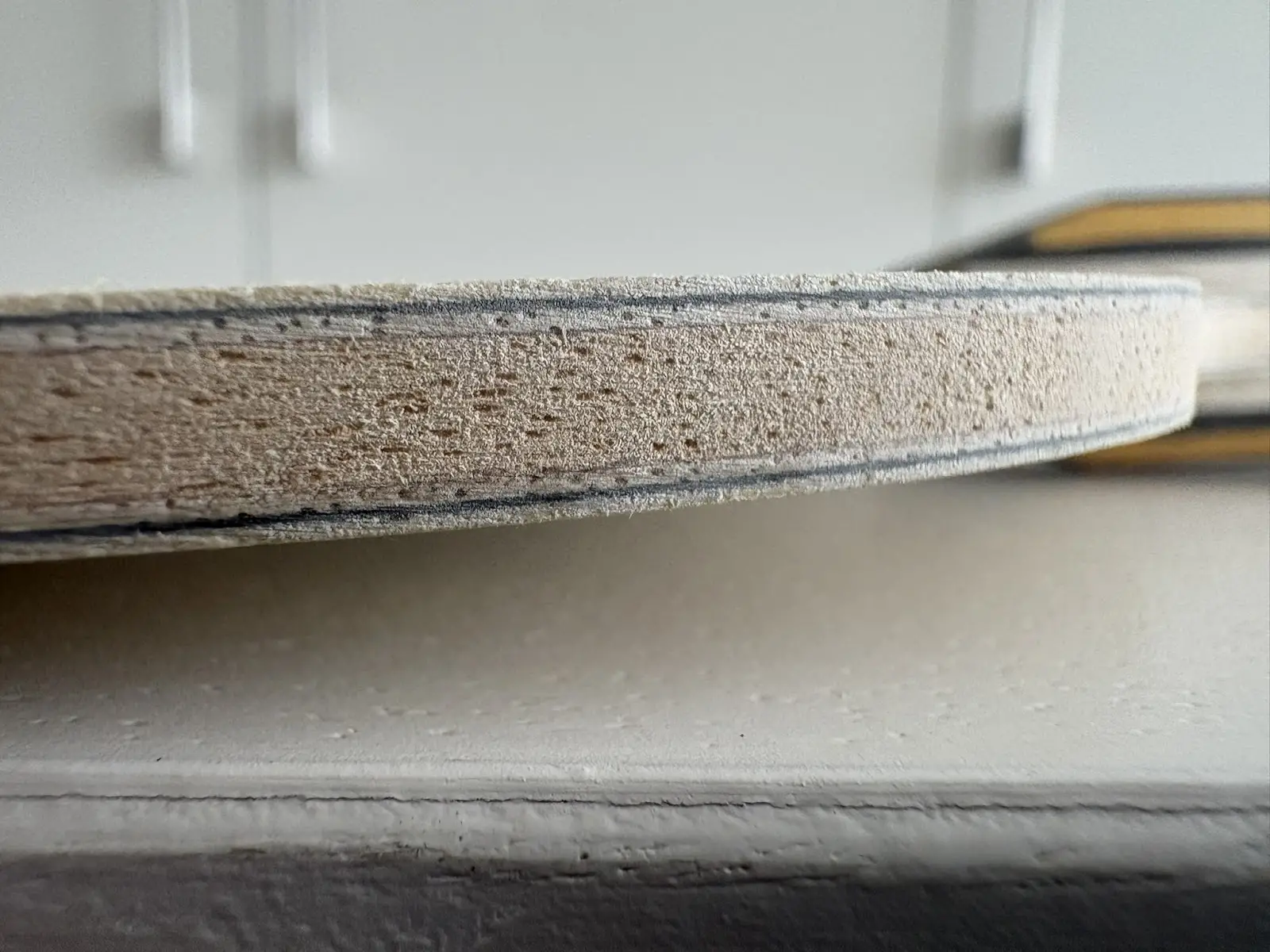
The Breeze’s two dark grey basalt fiber layers are clearly visible running parallel through the ply structure, positioned just inside the limba outer plies. The central triple-layer ayous core is the wide pale band between them.
Sanwei’s stated spec is approximately 97g with a variation of plus or minus 5 to 7g, meaning my 101g unit is within tolerance but at the upper extreme. Add even moderate rubbers at around 40g each side and you are holding a 181g+ assembled racket. Add thicker tensor rubbers and you can approach 200g. For context, most intermediate setups run 160 to 175g assembled.
Understanding Basalt Fiber
Basalt fiber is derived from volcanic rock, produced by extruding molten basalt into thin filaments that are woven into composite sheets. In blade construction it generally provides the following characteristics:
- Stiffer and faster than wood but less explosive than carbon, providing linear acceleration rather than a catapult effect
- Significantly better vibration dampening than carbon fiber because the volcanic structure absorbs shock rather than transmitting it harshly to the hand
- Softer acoustic profile with less of the high-pitched click associated with ALC and ZLC constructions
- In the Breeze’s outer position it produces a crisp, direct feel rather than the dwell-heavy character of inner-fiber designs
The Nittaku Basaltec is the only other prominent basalt-fiber blade line in table tennis, retailing at $150 to $250+. The Breeze at $40 is a four-fold price reduction for the same core material technology.
Value Assessment
At approximately $40, the Breeze sits in a genuinely unusual territory. Conventional outer-fiber OFF- blades at this price tier offer comparable speed but a very different experience thats harsher on contact and less forgiving on timing.
If you want composite speed without carbon harshness and cannot stretch to $100+, the Breeze has no meaningful competition at this price. The weight is the honest qualification. If 100+g is outside your comfort zone, no amount of feel quality will compensate for the fatigue it introduces over a long session.
- Construction: 5+2 Outer Basalt Fiber
- Outer Plies: Limba
- Core: Ayous
- Thickness: ~6.1mm
- Weight: ~97g ±5g (varies by individual blade)
- Speed Category: OFF-
- Handle Types: Flared, Straight, Chinese Penhold
Summary: A flat-attack specialist that delivers genuine basalt fiber comfort and OFF- pace at an unbeatable $40, provided you can live with the weight.
Playtesting Experience
I set up the flared-handle Breeze with Sanwei Target National on the forehand and backhand. The Target National is a low-throw hybrid rubber, and when paired with the Breeze’s already-low throw angle it creates an extremely flat, direct setup suited specifically to close-to-table attackers who drive through the ball rather than over it.
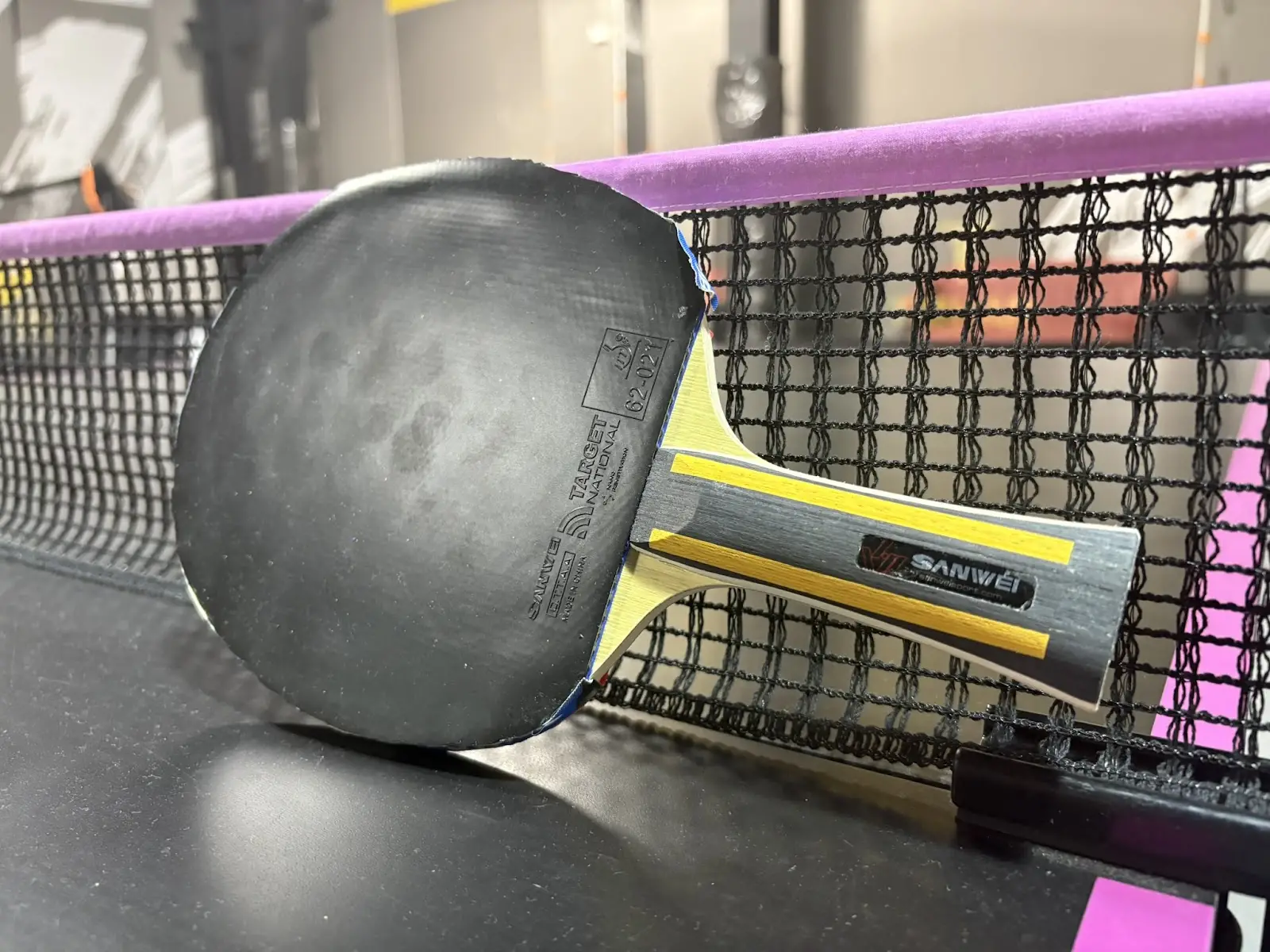
The blade makes an immediate statement on first contact. It is not an all-wood feel with a bit of extra pace.
The crispness on drives is closer to carbon than wood, but without the jarring stiffness you would expect from an outer-carbon blade at equivalent speed.
Speed and Control
The Breeze sits at the upper end of OFF- territory. Compared to a classic benchmark like the Stiga Clipper Wood it has meaningfully more pace on flat drives and a noticeably lower trajectory. It rewards early-ball timing. Strike at the top of the bounce and the blade does the work. Arrive late and the low throw punishes you with net errors.
The power delivery model is important to understand clearly. This is a flat-attack blade, not a looping blade. Drives and smashes respond directly and with real pace. Forehand loops work but the low throw demands precise technique to keep the ball on the table because there is no forgiving high arc to bail you out. Players who rely on heavy topspin for safety margin will find the Breeze frustrating, whilst players who hit through the ball will feel at home almost immediately.
Blocking is clean and purposeful. The outer basalt makes the blade stiff and responsive, so incoming topspin is redirected with pace rather than absorbed. This suits the player who blocks aggressively and looks to redirect for a winner rather than the player who wants to take pace off and angle wide.
The Target National pairing on the forehand reinforced the low-throw character of the blade, creating a very direct combination that left me almost no margin for high-arc safety shots. It was a setup that rewarded confidence and punished my hesitation.
The short game requires discipline. The outer basalt construction responds faster than a 5-ply all-wood, so drops, touch pushes, and receive work need a lighter grip pressure than you might expect from previous experience. The adjustment settles within two or three sessions but it is real and worth flagging for players transitioning from all-wood.
Feel
The Breeze’s feel is its most interesting attribute and the one that most directly validates the basalt story. On hard, committed drives the vibration profile is genuinely soft. There is a solid, purposeful thud at contact rather than the sharp feedback of outer carbon. Your hand registers that the ball was hit hard but it does not complain about it.
The dwell time is noticeably shorter than a 5-ply all-wood and shorter than an inner-fiber design like the Surge Prism. The ball comes off fast. You feel the limba outer make contact, the ball compresses briefly against the topsheet, and then the basalt layer launches it away cleanly. This blade is in a hurry.
Vibration damping sits at medium-low. Off-centre contacts on the periphery of the sweet spot are absorbed noticeably better than a comparable outer-carbon blade. Whilst I find off-centre drives are uncomfortable on carbon, on the Breeze they are merely informative.
Again, weight plays a factor here. Over a two-hour training block against heavy topspin the extra weight accumulates, particularly on the forehand. Players coming from lightweight 80g all-wood setup will feel this more acutely than those already used to heavier blades.
Value
The Breeze is competing in a category it has essentially created at this price point. Outer basalt fiber composite for under $50. That alone makes it worth taking seriously.
Against conventional OFF- blades in the $40 to $60 range, the Breeze offers a more comfortable alternative with comparable or better speed. The trade is the weight and the low throw, both real limitations for the wrong player.
For flat attackers who have been eyeing composite blades but found $100 to $150 ALC options out of reach, the Breeze at $40 is a genuine option rather than a consolation choice.
Alternatives to the Sanwei Surge Breeze

Nittaku Basaltec Outer
The reference standard for outer basalt fiber construction. If budget is not the constraint, the Basaltec is the benchmark.

Sanwei Surge Prism
The right choice if your game is loop-first rather than drive-first. It produces a high throw, more dwell, and a wood-like feel that rewards topspin technique.

Sanwei Surge Nitro
The most aggressive of the Surge siblings. This blade produces more outright speed than the Breeze with a medium throw that suits combined attack-and-loop play.
Overall Reflections
The Surge Breeze is a flat-attack blade with a genuinely distinctive material identity. It is fast, direct, vibration-dampened, and priced at a point where nothing comparable exists. The feel is meaningfully different from both all-wood and conventional carbon blades.
Its defining strength is the feel-to-speed ratio. You get OFF- pace and outer-fiber crispness without the arm punishment of carbon. For close-to-table attackers who drive and smash more than they loop, this is a compelling proposition.
The low throw rewards the players it is built for and asks more of everyone else, so you need to be honest about which player you are before buying.
The weight at 101g on my blade is the genuine limitation and the honest headline of this review. It narrows the field considerably. Players already running heavy setups or who play shorter sessions will adapt. Players transitioning from lightweight all-wood configurations across long training blocks will feel the difference acutely.
Rubber pairing note: Target National on the forehand is a low-throw rubber on an already low-throw blade, a very committed, flat setup that rewards confidence and punishes hesitation. If you want more margin over the net, consider a medium-throw tensor rubber with a slightly higher arc to compensate for the blade’s trajectory. Nittaku’s Fastarc G1 is a sensible starting point.
At approximately $40, the Sanwei Surge Breeze is an easy recommendation for the right player. If your game is built on flat drives, early-ball aggression, and close-to-table finishing, and the weight does not concern you, this blade is genuinely hard to argue against at this price.

David's been playing Table Tennis since he was 12, earning his first coaching license in 2012. He's played in national team & individual competitions, although he prefers the more relaxed nature of a local league match! After earning his umpiring qualification in England, David moved to Australia and started Racket Insight to share information about the sport he loves.
Blade: Stiga WRB Offensive Classic | Forehand: Calibra LT | Backhand: Xiom Musa
Playstyle: The All-Rounder