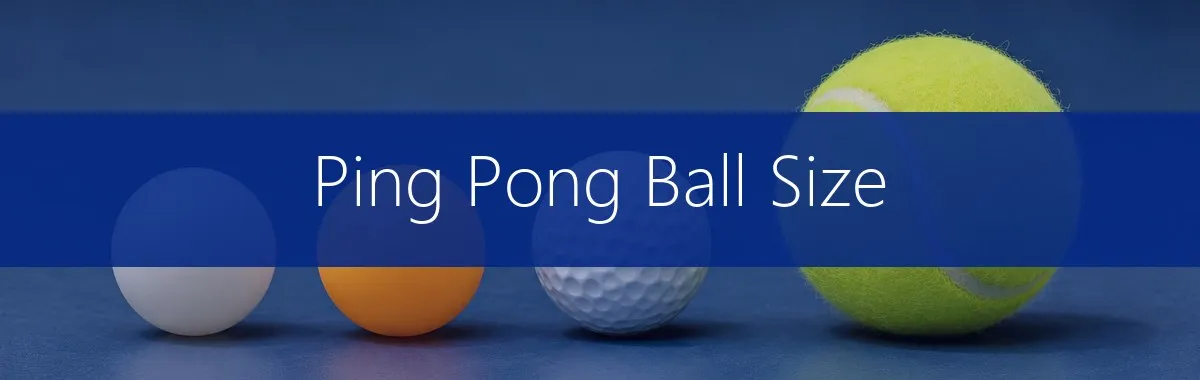
A ping pong ball is 40 mm (4 cm, or 1.57 inches) in diameter and weighs 2.7 grams (0.095 oz). That’s the official ITTF size. Every ball sold for club or tournament play is made to it.
Strictly, 40 mm is the smallest a modern ball is allowed to be. A plastic ball marked 40+ has to measure between 40.00 and 40.60 mm, so an approved ball is 40 mm or a hair over.
You don’t have to measure a ball to know it’s legal. If it has “ITTF” and “40+” printed on it, it has passed the tests below.
ITTF Laws of Table Tennis, rule 2.3
- Diameter
- 40 mm (4 cm)
- Weight
- 2.7 g
- Circumference
- 125.7 mm
- Color
- White or orange, matte
- Material
- Plastic (marked 40+)
40 mm = 4 cm = 1.57 inches. 2.7 g = 0.095 oz = 0.0027 kg. Any single approved ball may weigh 2.67 to 2.77 g and measure 40.00 to 40.60 mm across.
Official ITTF Ball Specs
Rule 2.3 of the ITTF Laws of Table Tennis says the ball must be spherical, 40 mm across and 2.7 g. It must be made of plastic and be white or orange with a matte finish. The rule doesn’t say how close to those numbers a ball has to be. The allowed ranges are in a separate ITTF document, Technical Leaflet T3: The Ball, which every ball brand has to pass to get approved.
| Spec | ITTF limit for a 40+ plastic ball |
|---|---|
| Diameter, any single ball | 40.00 to 40.60 mm |
| Diameter, average of the sample | 40.00 to 40.50 mm |
| Weight, any single ball | 2.67 to 2.77 g (one ball in 24 may fall outside) |
| Weight, average of the sample | 2.69 to 2.76 g |
| Out of round (widest minus narrowest diameter) | under 0.25 mm per ball, under 0.20 mm on average |
| Bounce | 240 to 265 mm when dropped from 305 mm onto a steel block |
| Veer | no more than 2 of 24 balls may drift 175 mm off line when rolled |
| Color | white or orange, matte |
| Marking | brand, “Made in” country, ITTF approval and “40+” |
The Laws say 40 mm and 2.7 g. ITTF approval testing allows these ranges.
- Any single ball
- Average of the 24-ball test sample
Diameter (mm)
Single ball 40.00 to 40.60 · Average 40.00 to 40.50
Weight (g)
Single ball 2.67 to 2.77 · Average 2.69 to 2.76
To approve a brand, the ITTF tests a sample of 24 balls. They sit for three days at 23°C and 50% humidity first, so every brand is measured in the same conditions. Each ball has to pass the single-ball limits. The 24 together also have to pass the average limits.
The sample also has to be consistent. The weights can’t vary by more than a standard deviation of 0.03 g, or the diameters by more than 0.06 mm, so a brand that makes some good balls and some bad ones fails even when its average looks fine. For a player, that’s most of what you pay for in an approved ball: the next one out of the box plays like the last one.
Ping Pong Ball Size in mm, cm and Inches
| Unit | Official size | Legal range (single 40+ ball) |
|---|---|---|
| Millimeters | 40 mm | 40.00 to 40.60 mm |
| Centimeters | 4 cm | 4.00 to 4.06 cm |
| Inches | 1.57 in | 1.575 to 1.598 in |
| Circumference | 125.7 mm (4.95 in) | 125.7 to 127.5 mm |
If you need one number for a homework question or a spec sheet, use 40 mm. The 1.57-inch figure is 1.5748 rounded.
How Much Does a Ping Pong Ball Weigh?
A ping pong ball weighs 2.7 grams. That’s 0.095 ounces, or 0.0027 kilograms.
| Unit | Official weight | Legal range (single ball) |
|---|---|---|
| Grams | 2.7 g | 2.67 to 2.77 g |
| Ounces | 0.095 oz | 0.094 to 0.098 oz |
| Kilograms | 0.0027 kg | 0.00267 to 0.00277 kg |
It takes about 370 balls to make a kilogram, or 168 to make a pound, so even a bucket of 100 robot balls weighs only 270 g. If you’re buying balls for a robot, worry about consistency before weight. Our robot training guide explains why thin, cheap balls throw off your timing.
The ball is so light because it’s hollow. Its whole volume averages about 0.08 grams per cubic centimeter, roughly 12 times less dense than water, which is why a ping pong ball floats so high.
Is a Ping Pong Ball the Same Size as a Golf Ball?
No. A golf ball has to be at least 42.67 mm across under the Rules of Golf, so it’s 2.67 mm wider than a ping pong ball. Side by side they look close, but the golf ball can weigh up to 45.93 g, about 17 times as much.
A tennis ball is in another class. The ITF sets its diameter at 6.54 to 6.86 cm and its weight at 56.0 to 59.4 g, so it’s about 1.7 times as wide as a ping pong ball and more than 20 times as heavy.
Drawn to scale with each other. Sizes and weights are the limits in each sport's rules.
- Old ball (to 2000)
- Ping pong ball
- Golf ball
- Large ball (Japan)
- Jumbo novelty ball
- Tennis ball
A golf ball is 2.67 mm wider than a ping pong ball and can be up to 17 times heavier.
Other Ball Sizes You’ll See
38 mm balls (the old size)
Until September 2000, the official ball was 38 mm across and weighed 2.5 g. You’ll still find old 38 mm balls in garages and on secondhand sites. They aren’t legal in any sanctioned event today. Next to a 40+ ball they look and feel noticeably smaller. If you find a tube of them, they’re fine for a knock-about at home, but don’t train with them: you’d be getting used to a ball you’ll never see in a match.
44 mm large balls
Japan has its own large-ball format, started in 1988. The Japan Table Tennis Association’s rules set the ball at 44 mm and 2.2 to 2.4 g, in matte orange. The net goes up to 17.25 cm, against the standard 15.25 cm. The bigger, lighter ball is slower through the air than a 40 mm ball. You’ll see 44 mm balls sold outside Japan as training or recreational balls.
55 mm jumbo balls
Jumbo 55 mm balls are novelty and beginner training products from brands such as JOOLA and Butterfly. No governing body uses them for competition. They’re sold as easy-to-see training aids for beginners.
Beer pong balls
Beer pong uses ordinary ping pong balls. Most packs are sold as 40 mm. No rulebook sets a weight or roundness standard for them, so expect cheaper plastic and more variation than a competition ball. Most beer pong packs aren’t ITTF approved. An approved ball has “ITTF” and “40+” printed on the ball itself.
Why the Ball Got Bigger: 38 mm to 40 mm to 40+
The ITTF agreed in February 2000 to replace the 38 mm ball with a 40 mm one. The change took effect on October 1, 2000, just after the Sydney Olympics. The goal was to slow rallies and cut spin, which made the game easier to follow for spectators and on TV. The new ball is 5.3% wider than the old one and has 16.6% more volume.
The second change was the material. From July 1, 2014, ITTF events switched from celluloid to non-celluloid plastic balls, marked “40+”. Celluloid is flammable and breaks down over time. Today’s Laws simply say the ball is made of plastic.
-
Until Sept 2000
38 mm celluloid
2.5 g. White, yellow or orange.
-
From Oct 1, 2000
40 mm celluloid
2.7 g. Made bigger to slow rallies and cut spin.
-
From July 1, 2014
40+ plastic
Same 40 mm and 2.7 g, in non-celluloid plastic.
The first plastic balls weren’t very round and cracked easily. It took manufacturers a few years to get them right. If you’re coming back to the game after a long break, expect today’s ball to feel harder and take less spin than the celluloid ball you remember. Choppers lost the most in the switch. Our history of the ping pong ball covers how each change reshaped the game.
Color, Material and Markings
A legal ball is white or orange, with a matte finish so it doesn’t flash under the lights. The ITTF checks the shade with a spectrophotometer against fixed white and orange references. Pick the color that stands out against your walls and floor: orange against white or pale walls, white against dark backgrounds.
Every approved plastic ball carries a stamp with four things: the brand name, “Made in” plus the country, the ITTF approval (as “ITTF”, “ITTF approved” or the logo) and “40+”. The “40+” tells you it’s a non-celluloid ball.
The box also has to carry a four-letter date code: two letters for the month, then two for the year, where A to I stand for 1 to 9 and X stands for 0. XEAA means 05/11, so May 2011. It’s a quick way to see how long a box has been sitting on a shop shelf.
Stars are each maker’s own grading. The ITTF’s only rule is that no ball can be graded higher than three stars. Our guide to choosing a table tennis ball by star rating explains what the grades mean when you buy.
The ITTF Bounce Test and Other Lab Checks
To test bounce, the lab drops each ball without spin from 305 mm onto a steel block at least 20 mm thick. It films the rebound against a millimeter scale and takes the geometric mean of three drops. Every one of the 24 balls must rebound to between 240 and 265 mm. Tables get a similar test: a regulation table has to give a bounce of about 23 cm when a standard ball is dropped from 30 cm, which our ping pong table dimensions guide covers.
Drop heights drawn to scale. Heights are measured to the bottom of the ball.
All 24 balls in a test sample must land in the band. The limit for the old celluloid ball was 260 mm.
Three more lab tests decide whether a ball plays true:
- Roundness: the lab spins the ball about several axes and records the widest and narrowest diameter. A 40+ ball can be no more than 0.25 mm out of round.
- Veer: the ball rolls down a 100 mm ramp set at 14 degrees and across a flat surface. It fails if it drifts 175 mm off the center line twice in three rolls. No more than two balls in the sample may fail.
- Hardness: the lab presses a 20 mm pin into the ball with 50 N of force and measures the dent. For a seamed ball, the average at the poles must fall between 0.68 and 0.81 mm.
Factories run similar checks on the production line before balls are graded, which our guide to how ping pong balls are made walks through step by step. When you’re picking a box to buy, our ball picks for training and matches are the next stop.
Ping Pong Ball Math for Students
A table tennis ball turns up in a lot of physics homework, usually as “a ball with a mass of 2.7 g and a diameter of 40 mm”. These are the numbers that come out of it, with the radius r = 2.0 cm.
- Circumference: C = πd = π × 4.0 cm = 12.57 cm (125.7 mm)
- Surface area: A = 4πr² = 4π × 2.0² = 50.3 cm²
- Volume: V = (4/3)πr³ = (4/3)π × 2.0³ = 33.5 cm³
- Average density: ρ = m / V = 2.7 g ÷ 33.5 cm³ = 0.081 g/cm³, about 1/12 of water
- Weight force: W = mg = 0.0027 kg × 9.81 m/s² = 0.026 N
- Bounce test rebound ratio: rebound ÷ drop = 240 to 265 mm ÷ 305 mm = 0.79 to 0.87
The density figure treats the ball as solid. The plastic shell itself is denser than water; the ball floats because nearly all of it is air.
Frequently Asked Questions
How big is a 40 mm ball?
A 40 mm ball is 4 cm, or 1.57 inches, across. That's the official size of a ping pong ball. It's a little smaller than a golf ball, which must be at least 42.67 mm. Approved 40+ plastic balls measure between 40.00 and 40.60 mm.
Is there a difference in ping pong balls?
Yes. Every ITTF-approved ball sits inside the same size and weight windows, but brands and grades differ in roundness, hardness, seam quality and how consistent one ball is with the next. Old celluloid balls also play differently from today's plastic 40+ balls. See choosing a table tennis ball for how the star grades compare.
What is the ping pong ball size in cm?
A ping pong ball is 4 cm in diameter. A single approved 40+ ball may measure 4.00 to 4.06 cm. Its circumference is about 12.6 cm.
How much does a ping pong ball weigh in kg?
A ping pong ball weighs 0.0027 kg (2.7 g). The ITTF accepts 2.67 to 2.77 g for any single ball. About 370 balls make up one kilogram.
Are beer pong balls the same as ping pong balls?
Beer pong uses ordinary ping pong balls. Most are sold as 40 mm. No rulebook sets a weight or roundness standard for beer pong, so cheap packs vary more than competition balls. Most aren't ITTF approved; an approved ball has ITTF and 40+ printed on it.
Can you play with 38 mm balls?
Yes, for casual games at home. The 38 mm ball was replaced on October 1, 2000, so it isn't legal in any sanctioned event. It's smaller and lighter (2.5 g), so it feels and plays differently from a 40+ ball.



Comments